By CookieGrove Editorial Desk. Last updated June 2026.
Gluten free cookies fail for one reason more than any other: the dough never got the chance to hydrate, so it bakes gritty and crumbly. The fix is simple. Use a 1:1 blend that already contains xanthan gum, weigh your flour in grams instead of scooping, and let the dough rest at least 30 minutes before it touches the oven. Do those three things and a gluten free cookie can be every bit as chewy and tender as a wheat one.
In cookies baked without wheat, the biggest improvement comes not from a fancy ingredient but from understanding what gluten was doing in the first place. Gluten is the protein web that traps air and holds a cookie together. Take it away and you have to rebuild that structure with starch, a binder, and time. Below is exactly which flour to buy or blend, the binder math, the rest that makes or breaks the texture, and a troubleshooting table that tells you which mistake caused your specific disaster.
A quick word on where this comes from. The advice below is what survived years of failed batches, not what reads well in a textbook. A classic failure is a tray of shortbread so sandy it goes straight in the trash, all because the flour was scooped instead of weighed and the rest was skipped.
Pick Your Flour Path First
Before you choose a recipe, choose a flour strategy. This is the fork in the road the other guides bury under a list of twelve flour names. There are really three paths, and they lead to different cookies.
| Path | What it is | Best for | Watch out for |
|---|---|---|---|
| 1:1 measure-for-measure blend | A pre-mixed cup-for-cup flour with starch and a binder built in (King Arthur Measure for Measure, Bob’s Red Mill 1-to-1, Cup4Cup) | Converting any wheat cookie recipe with the least fuss | Not all are equal; some run grittier or spread more |
| DIY multi-flour blend | You mix rice flour, starches, and a binder yourself by weight | Control freaks and bulk bakers who want to tune texture | Needs a scale and a known formula; easy to get wrong |
| Single nut or seed flour | Almond or coconut flour as the whole flour | Shortbread, macaroons, delicate or low-carb cookies | Does not swap 1:1; behaves completely differently |
For most people starting out, buy a quality 1:1 blend that already lists xanthan gum on the label. The educational guides from King Arthur Baking are a dependable reference for how their Measure for Measure blend behaves in cookies. It is the path with the fewest landmines. The DIY route is rewarding once you are comfortable, and single nut flours are their own world worth exploring, like in these almond meal chocolate chip cookies where the almond flour is the whole point, not a substitute.
Not all 1:1 blends behave the same
Here is a point that is easy to learn the slow way. Consider the exact same chocolate chip recipe baked twice on the same afternoon, changing only the brand of 1:1 flour. One batch spread to about 3 inches wide and went thin and lacy. The other stayed under 2.5 inches, thick and domed. Same recipe, same 350F oven, same butter, weighed to the gram. The blends use different ratios of rice flour to starch to whole-grain flour, and that changes how much the dough spreads and how it browns. So when you find a blend that gives you the texture you love, stick with it, and do not assume another brand is interchangeable.
The Binder: Xanthan, Psyllium, and Why It Matters
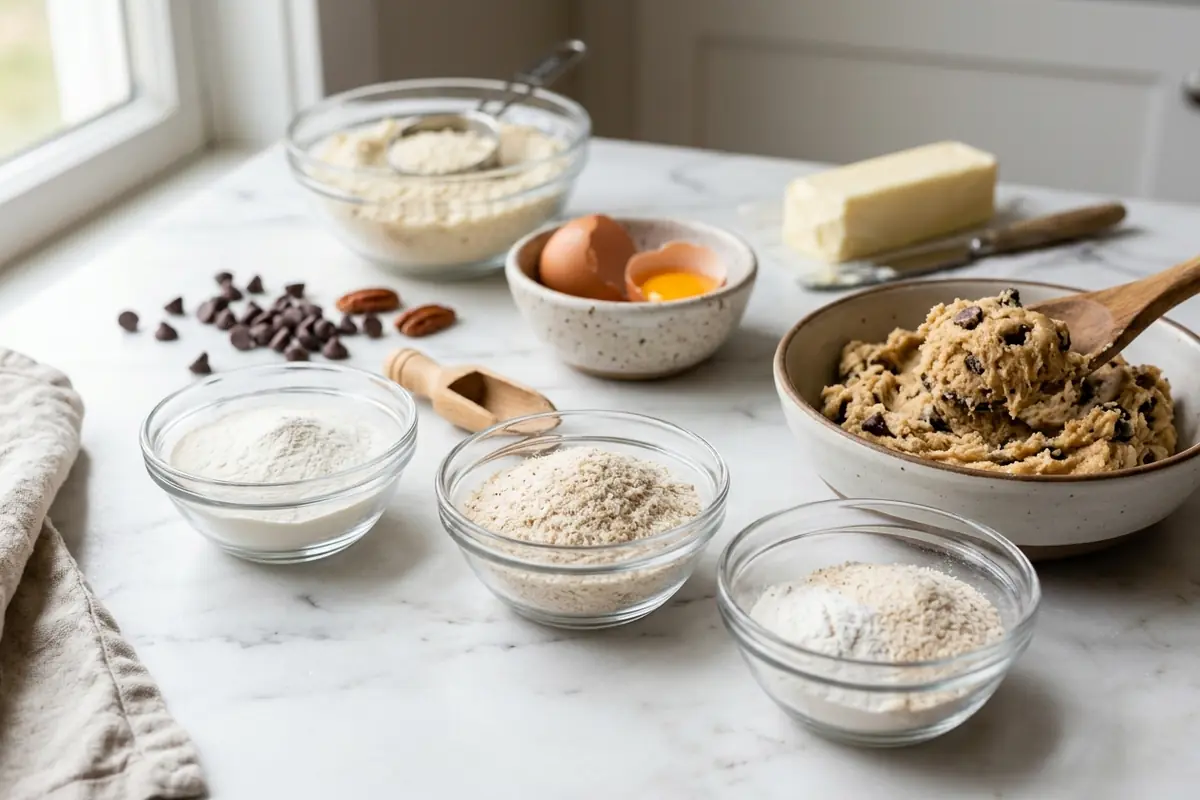
Gluten gives dough stretch and hold. Without it, a binder does that job. The most common is xanthan gum. If your flour blend does not already contain one, add 1/4 teaspoon of xanthan gum per cup of flour for cookies. Too much and the cookie turns gummy and tight; too little and it crumbles when you lift it. That quarter-teaspoon-per-cup is the reliable starting point.
Psyllium husk is the binder to choose for real structure, like in a cookie that has to hold a thick shape or a cutout that needs crisp edges. It holds water and gives a sturdier, breadier set than xanthan. For most drop cookies, though, xanthan is plenty. Ground flax or chia mixed with water (a flax egg) also binds and adds a little chew, which works nicely in oatmeal-style cookies where a bit of heartiness is welcome.
| Binder | Amount | Gives you |
|---|---|---|
| Xanthan gum | 1/4 tsp per cup of flour | Chew and hold; the all-purpose choice |
| Psyllium husk | 1 to 2 tsp per batch | Sturdy structure for thick or cutout cookies |
| Flax or chia egg | 1 tbsp ground + 3 tbsp water | Mild chew and binding for hearty cookies |
Weigh, Do Not Scoop
This is the rule that quietly fixes more gluten free cookie problems than any ingredient. Gluten free flours are dense and pack differently than wheat flour, so scooping straight from the bag compacts the flour and you end up with far too much. Too much flour means dry, crumbly, sandy cookies. A digital kitchen scale costs about $12 and ends the guessing. When a recipe gives grams, use them. When it only gives cups, the safe conversion for most 1:1 blends is roughly 140 grams per cup, but a recipe’s stated gram weight is always more reliable than a cup measure.
If you must use cups, spoon the flour gently into the cup and level it off with a knife. Never dip the cup into the bag. That one habit alone can be the difference between a cookie that holds together and one that falls apart on the cooling rack. The same precision pays off when you are cutting sugar too, as in these low sugar oatmeal cookies, where every gram of the structure-building ingredients matters more once the sugar is reduced.
The Hydration Rest: The Step Almost Everyone Skips
Here is the technique that separates gritty gluten free cookies from tender ones. It is called the hydration rest, and it is the one step not to skip. The starches in gluten free flour need time to absorb the liquid in the dough. Bake immediately and those starch granules are still dry in the center, which reads on your tongue as grit or sand. Give the dough a rest and the starches drink up the moisture, the dough smooths out, and the baked cookie loses that telltale gritty edge.
Rest the dough in the fridge for at least 30 minutes. Overnight is better. When the rest is the only variable, the overnight batch comes out noticeably smoother and chewier, with deeper flavor from the longer hydration. This rest does double duty: it also firms the butter so the cookies hold their shape instead of spreading into puddles, which gluten free doughs are prone to do. If you want the cookbook-grade reasoning behind resting dough, America’s Test Kitchen has written extensively on how hydration time changes baked texture.
Troubleshooting: Match the Flaw to the Fix
This is the table the top guides leave out. Read your cookie, find the symptom, fix the cause.
| Symptom | Likely cause | The fix |
|---|---|---|
| Crumbly, falls apart | Too much flour or not enough binder | Weigh flour, add 1/4 tsp xanthan per cup, cool fully before moving |
| Gritty or sandy on the tongue | Starches did not hydrate | Rest dough 30 min to overnight; mix dry ingredients a minute longer |
| Spread thin and greasy | Dough too warm; blend low on structure | Chill dough; try a sturdier 1:1 blend; raise oven 15F |
| Gummy or dense center | Too much binder or underbaked | Cut xanthan slightly; bake 1 to 2 min longer; add a bit more leavener |
| Dry and hard | Overbaked or over-floured | Pull when edges just set; recheck flour weight |
Two extra moves help almost every gluten free batch. Mix the dough a little longer than you would for wheat, a full minute or two after the dry ingredients go in, to develop structure and knock out grittiness. And add a touch more leavener, an extra 1/4 teaspoon of baking soda or powder per batch, because gluten free doughs can bake up denser without that lift. For more on ingredient swaps and how they change a bake, the test cooks at Bon Appetit cover substitution science well.
Building Your Own Gluten Free Flour Blend
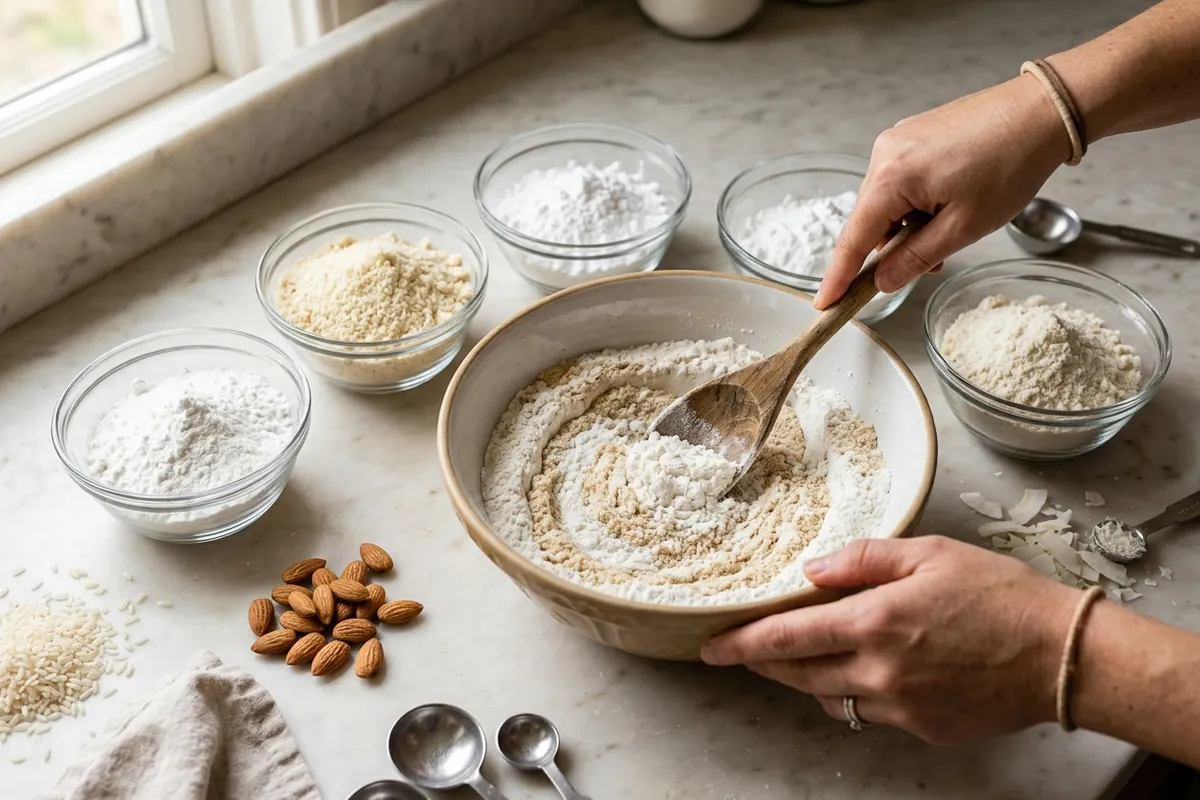
Once you are comfortable, mixing your own blend gives you control and saves money if you bake often. A reliable all-purpose cookie blend leans on a neutral flour for bulk, a starch or two for tenderness, and a binder for hold. A dependable formula, by weight, is roughly 40 percent white rice flour, 20 percent brown rice flour, 20 percent tapioca starch, 20 percent potato starch, plus 1/4 teaspoon of xanthan gum per cup of the finished blend. Whisk it well and store it airtight.
Why those parts? Rice flour gives structure and a neutral taste, but on its own it is gritty and dry. The starches, tapioca and potato, soften that, add tenderness, and help the cookie spread and brown the way wheat does. Brown rice flour brings a little more body and a faint nutty note. If you want a chewier, deeper cookie, swap 10 percent of the rice flour for sorghum, which behaves a lot like a soft wheat flour. Millet adds a mild corn-like sweetness and works in oatmeal-style cookies, while buckwheat brings an earthy, dark flavor that suits chocolate and gingerbread doughs. Teff and amaranth are stronger-flavored options for bakers who want more whole-grain character. The point is that no single flour does the job; a blend mimics what wheat does naturally.
Match the flour to the cookie. Almond flour shines in shortbread, snickerdoodles, and macaroons. Oat flour, certified gluten free, gives a soft, homey crumb that suits oatmeal and chocolate chip. Coconut flour is the oddball: it drinks up moisture and needs extra eggs, so use it only in recipes written for it. Sorghum and buckwheat carry darker, spiced cookies like molasses and gingersnaps. Knowing each flour’s personality is half the battle.
Buy a superfine rice flour if you can find it. The coarser, cheaper rice flours are the number one source of that sandy texture people complain about in homemade gluten free cookies. Grind matters as much as ratio.
Flavor: Gluten Free Does Not Mean Flavorless
The plain rice-heavy blends can taste a little flat, so flavor builders help. Browned butter is the most effective trick: cooking the butter until the milk solids turn golden adds a nutty, toffee depth that covers any faint rice taste and makes the cookie taste richer than a wheat version. A teaspoon of real vanilla, a pinch more salt than you think you need, and a little molasses or brown sugar all push flavor forward and distract from any starchy notes.
Toasting your flour blend in a dry skillet for a few minutes before mixing also deepens flavor and cuts the raw-starch taste, a trick borrowed from shortbread bakers. The recipe developers at Cook’s Illustrated have run the same toasted-flour test and found it measurably reduces the raw, pasty note that plagues rice-based blends. These small moves are the difference between a gluten free cookie that tastes like a compromise and one that tastes like a cookie you would choose on its own merits.
Storage, Freezing, and Make-Ahead
Gluten free cookies stale faster than wheat ones because the starches firm up quickly, a process called retrogradation. Eat them within two to three days for best texture, and store them airtight at room temperature. A slice of bread tucked in the container helps keep them soft by sharing its moisture.
The better make-ahead move is to freeze the dough, not the baked cookies. Scoop dough balls, freeze them solid on a tray, then bag them. Bake straight from frozen, adding a minute or two, and you get a fresh, just-baked cookie any night you want one. The hydration rest happens in the freezer over time, so frozen-then-baked gluten free dough often turns out smoother than dough baked the same day. A bag of frozen dough balls from recipes like these pumpkin chocolate chip cookies can stay ready to bake, and gluten free versions are expected to hold up to freezing just as well. If you bake a lot of gluten free goods, the gluten-free desserts hub at RecipesBend has plenty of ideas beyond cookies.
Converting a Beloved Wheat Recipe
Maybe you have a family chocolate chip recipe you refuse to give up. You can usually convert it, and the success rate is high if you respect a few rules. Start by swapping the wheat flour for a 1:1 measure-for-measure blend by weight, not by volume. If your blend lacks xanthan gum, add 1/4 teaspoon per cup of flour. Then build in the two habits gluten free dough demands: chill the dough at least 30 minutes and bake on parchment.
Expect the first conversion to need one tweak. If the cookies spread too much, your blend is light on structure, so add two tablespoons more flour or chill harder next time. If they come out dry, you likely over-measured, so weigh next round. If they taste gritty, you rushed the rest. Keep notes on what you changed, because the second batch of a converted recipe is almost always the keeper. Write the tweak right on the recipe card so you never have to relearn it.
One caution: very delicate cookies that rely on a thin, crackly structure, like a classic tuile, are the hardest to convert and may be better left to dedicated gluten free recipes. Sturdy drop cookies, bars, and thumbprints convert beautifully. Cutouts work too as long as you add a sturdier binder like psyllium so the shapes hold their edges. Even a buttery imprinted cookie like these chessman cookies can be adapted if you use psyllium and chill hard, though the crisp imprint takes practice.
A quick word on cross-contamination
If you are baking for someone with celiac disease rather than a preference, the flour is only half the job. Oats must be certified gluten free, since standard oats are cross-contaminated in the field and mill. Check that your baking powder, vanilla, and add-ins are labeled gluten free, and use clean pans and utensils that have not held wheat flour. The flour blend can be flawless and a shared sifter can still make someone sick, so treat the whole workspace, not just the recipe.
Why This Matters
Gluten free cookies get a bad reputation they no longer deserve. The crumbly, gritty cookies of a decade ago came from bad flour and skipped steps, not from any law of physics. Buy a 1:1 blend with a binder built in, weigh your flour so you do not over-pack it, and give the dough a real rest so the starches can hydrate. Match your binder to the cookie you want, lean on the troubleshooting table when something goes sideways, and freeze dough for fresh cookies on demand. Do that and nobody at the table will guess these were made without wheat.
FAQ
What is the best flour for gluten free cookies?
For most bakers, a quality 1:1 measure-for-measure blend that already contains xanthan gum, like King Arthur Measure for Measure or Bob’s Red Mill 1-to-1, is the easiest path. It swaps into wheat recipes cup for cup. Almond and coconut flours are for specific cookie styles, not general substitutes.
Why are my gluten free cookies crumbly?
Usually too much flour or not enough binder. Weigh your flour instead of scooping, add 1/4 teaspoon of xanthan gum per cup if your blend lacks it, and let the cookies cool completely before you move them, since they are fragile while warm.
Do I need xanthan gum in gluten free cookies?
If your flour blend already lists xanthan gum, no. If it does not, add about 1/4 teaspoon per cup of flour to give the cookies the chew and hold that gluten normally provides. Too much makes them gummy, so do not overdo it.
Why do my gluten free cookies taste gritty?
The starches did not have time to absorb the liquid. Rest the dough in the fridge for at least 30 minutes, ideally overnight, so the flour hydrates fully. Mixing the dough a little longer also helps eliminate grittiness.
Can I just swap gluten free flour into any cookie recipe?
With a 1:1 measure-for-measure blend, usually yes, especially if it contains a binder. Single flours like almond or coconut do not swap one for one and need recipes written for them. Starting with a well-documented gluten free recipe gives the most reliable result.
How long do gluten free cookies stay fresh?
Two to three days at room temperature in an airtight container, since gluten free cookies firm up faster than wheat ones. For longer storage, freeze the unbaked dough balls and bake from frozen whenever you want a fresh cookie.
Why do my gluten free cookies spread too much?
The dough was too warm or your flour blend is low on structure. Chill the dough before baking, use a sturdier 1:1 blend, and try raising the oven temperature about 15F so the edges set before the cookie can run flat.