By CookieGrove Editorial Desk. Last updated June 2026.
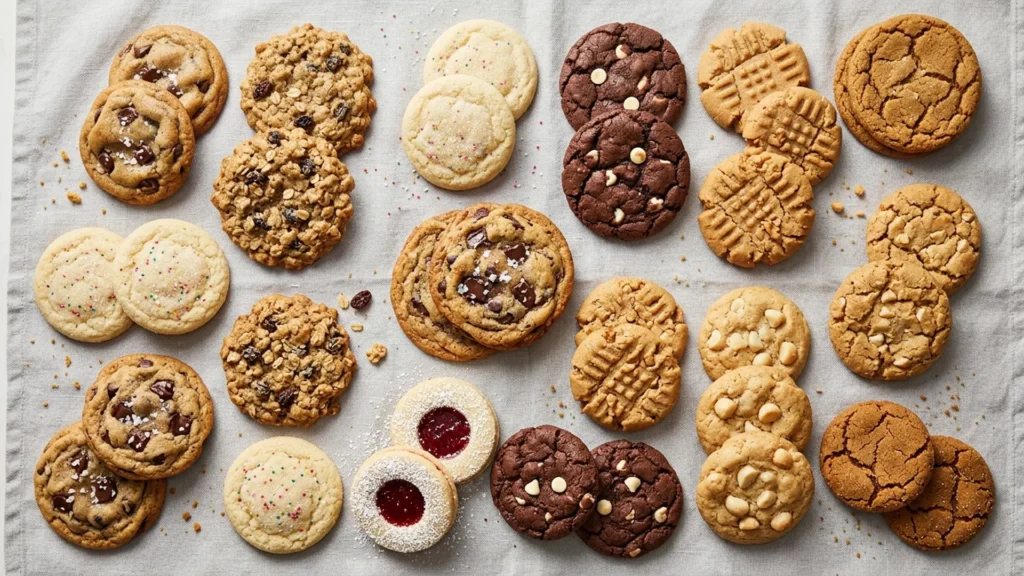
Types of cookies fall into six baking categories defined by how the dough is shaped, not by flavor: drop, bar, rolled or cutout, molded or shaped, refrigerator or icebox, and pressed. Once you know which category a cookie belongs to, you can predict how the dough behaves, how it spreads, and how to bake it. Everything else, the chocolate chips, the sprinkles, the spices, is just variation on top of one of these six methods.
The most common question from new bakers is some version of “why did this cookie do that?” Nine times out of ten the answer lives in the category. A classic example is sugar cookies that puff into shapeless blobs, because a cutout dough has to be stiff and cold. A drop cookie spreads because it is meant to. A rolled cookie holds a sharp edge because the dough was built stiff and cold. Learn the six families and you stop guessing. Below is the full map, what defines each type, the temperature and texture you should expect, and how to choose the right category for the cookie you actually want.
The Six Core Categories at a Glance
Here is the whole landscape in one table. Every classic cookie you can name belongs to one of these six, and the method, more than the recipe, determines the result.
| Type | How it is shaped | Classic examples | Typical bake |
|---|---|---|---|
| Drop | Soft dough scooped or dropped onto the sheet | Chocolate chip, oatmeal, snickerdoodle | 350F, 10-12 min |
| Bar | Batter pressed into a pan, baked, then cut | Brownies, blondies, lemon bars | 325-350F, 20-35 min |
| Rolled / cutout | Stiff chilled dough rolled flat and cut with cutters | Sugar cutouts, gingerbread, shortbread shapes | 350-375F, 8-11 min |
| Molded / shaped | Dough shaped by hand into balls, crescents, or logs | Peanut butter, thumbprints, Mexican wedding | 350F, 9-12 min |
| Refrigerator / icebox | Dough formed into a log, chilled, then sliced | Slice-and-bake, pinwheels, checkerboards | 350-375F, 9-12 min |
| Pressed | Soft dough forced through a cookie press | Spritz, butter wreaths | 350-375F, 8-10 min |
A quick note that clears up a lot of confusion online. You will see some guides list “shortbread” as one of the six. Shortbread is a dough style, defined by a high butter ratio and no leavening, not a shaping method. You can make shortbread as a cutout, a molded cookie, or an icebox log. So treat shortbread as a flavor-and-texture family that runs across several categories, not as a seventh type.
Drop Cookies: The Everyday Workhorse
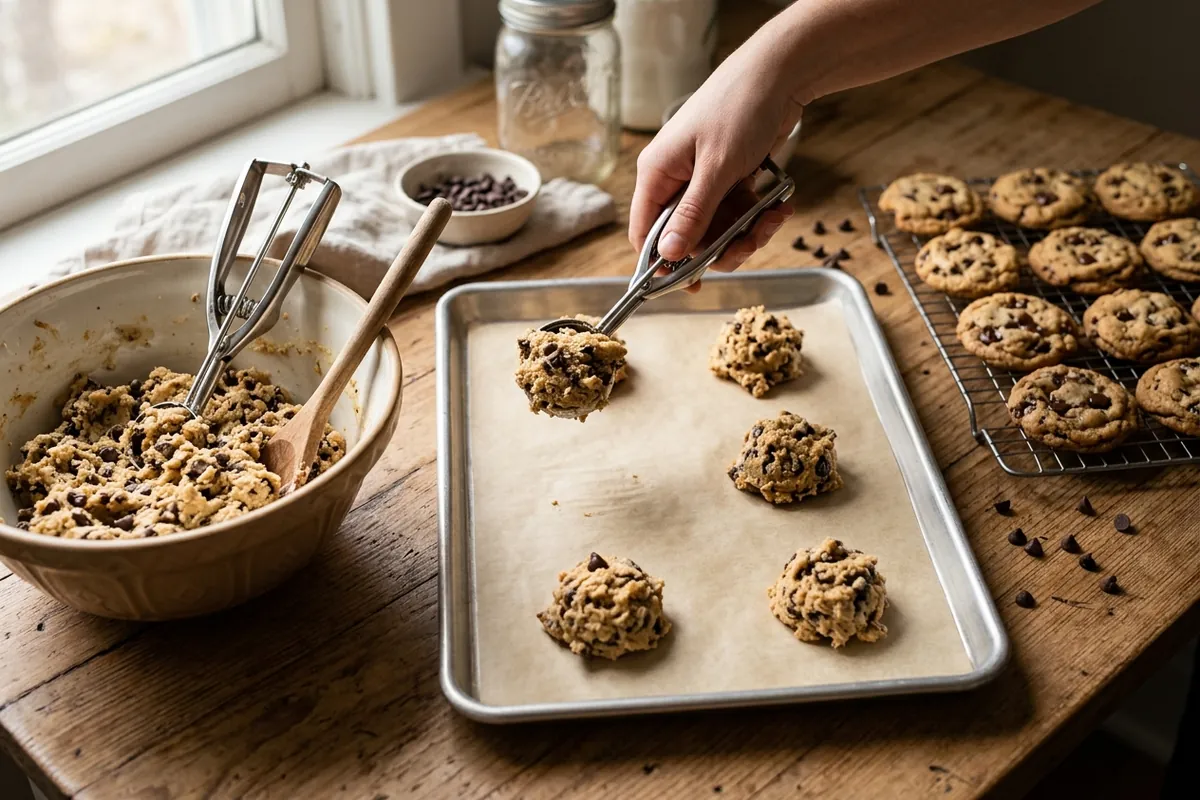
Drop cookies are the ones most people picture when they hear the word cookie. You make a soft dough, scoop it, and drop the mounds onto a sheet where they spread as they bake. The chocolate chip and the oatmeal are the famous members. Because the dough is soft and full of leavening, drop cookies flatten and spread, so leave at least 1.5 to 2 inches between them or they merge into one continental cookie.
The texture of a drop cookie is a direct result of fat, sugar, and chilling. More butter and white sugar mean more spread and crispness; more brown sugar and flour mean thicker and chewier. This is the category where chilling the dough matters most, because warm soft dough spreads into greasy puddles. A dough leaning on browned butter and sourdough discard, like these sourdough discard chocolate chip cookies, behaves like a classic drop cookie but with extra depth from the fermentation.
Bar Cookies: The No-Fuss Crowd Feeder
Bar cookies skip the shaping entirely. You spread a batter or thick dough into a pan, bake the whole slab, and cut it into squares once it cools. Brownies and blondies are the headliners, with lemon bars and seven-layer bars close behind. This is the category to reach for when you need to feed a crowd and do not want to babysit twelve trays.
Bars bake lower and longer than most cookies, usually 325F to 350F for 20 to 35 minutes, because the mass is thick and the center needs time to set. The single most common bar mistake is overbaking. Pull them when a toothpick comes out with a few moist crumbs, not clean, since they firm up as they cool. Line the pan with parchment, leaving an overhang, so you can lift the whole slab out and cut clean squares on a board.
Rolled and Cutout Cookies: Built for Decoration
Rolled cookies start as a stiff, often chilled dough that you roll flat and cut into shapes with cutters. Sugar cookies and gingerbread are the classics, the canvas for icing, sprinkles, and holiday decorating. The dough has to be sturdy and low on leavening so the shapes stay sharp and do not puff or spread into blobs.
The keys here are a firm dough and a cold one. Roll between two sheets of parchment to avoid working in too much extra flour, which dries the cookie. Chill the cut shapes on the tray for 15 minutes before baking so they hold their edges. Bake a touch hotter, 350F to 375F, for a shorter time so the edges set before they can spread. If you want crisp cutouts, bake a minute longer; for softer ones, pull them the moment the edges firm. The team at King Arthur Baking has detailed guides on roll-out dough consistency that are worth a read.
Molded and Shaped Cookies: The Hand-Formed Family
Molded cookies are shaped by hand before baking. You roll balls, press them with a fork like a peanut butter cookie, make a well for jam like a thumbprint, or roll crescents like Mexican wedding cookies. The dough is firm enough to hold a shape but not so stiff it cracks. These cookies are forgiving and fun, and they are where a lot of family traditions live.
Because you control the shape, you control the spread. A tightly rolled ball bakes up taller; a flattened disk bakes wider and crisper. Snickerdoodles fall here too, rolled in cinnamon sugar before baking. If you love a buttery, tender hand-shaped cookie, the technique behind chessman cookies shows how a firm butter dough takes and holds an imprint, which is the molded principle in action.
Refrigerator and Icebox Cookies: The Underrated Make-Ahead
This is the most underrated category, and a strong case can be made for it against any cookie purist. You mix the dough, roll it into a log, wrap it, and chill it firm. Then you slice rounds off the log and bake only what you want, when you want. The chilled log gives clean, uniform edges and lets you keep dough ready for weeks. Pinwheels and checkerboard cookies live here, built by stacking and rolling colored doughs.
For a busy week, an icebox log in the fridge or freezer means a fresh cookie in fifteen minutes any night, no mixing bowl required. Slice them about a quarter inch thick for even baking, and if the log softens too much to cut clean, pop it back in the freezer for ten minutes. This is one of the most useful categories, and almost nobody talks about it. You can even take a drop-cookie dough, chill it as a log, and slice it instead of scooping, which is a great trick for a more uniform cookie. Many lower-sugar doughs, like these low sugar oatmeal cookies, slice cleanly from a chilled log because the reduced sugar firms the dough.
Pressed Cookies: Precision and Pretty Shapes
Pressed cookies are made by forcing a soft, smooth dough through a cookie press fitted with a decorative disk. Spritz cookies are the classic, those buttery little wreaths and stars that show up at the holidays. The dough has to be soft enough to extrude but firm enough to hold the pattern, which is a narrow window.
The trick with pressed cookies is dough temperature. Too cold and it will not push through the press; too warm and the pattern slumps. Press onto a cool, ungreased metal sheet so the dough grips and releases from the press cleanly. Bake at 350F to 375F just until the edges barely color, since these are thin and turn from done to overdone fast. Pressed cookies are the most equipment-dependent category, but the uniform, ornate results are hard to match by hand.
How to Choose the Right Type
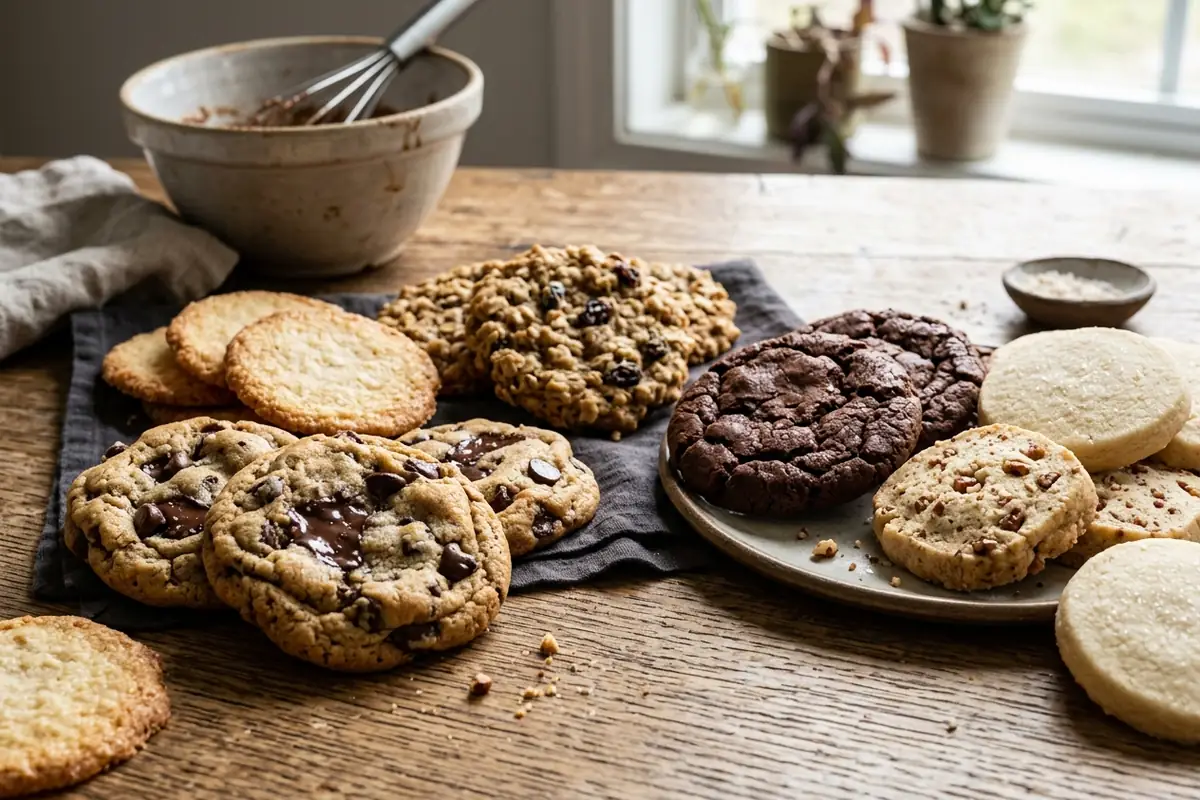
Stop picking a cookie by photo and start picking by goal. Here is a quick decision shortcut.
| If you want… | Choose this type |
|---|---|
| Fastest with the least cleanup | Bar cookies (one pan, cut and go) |
| Classic chewy or crisp everyday cookie | Drop cookies |
| Decorated shapes for holidays or gifts | Rolled / cutout |
| Make-ahead dough, bake on demand | Refrigerator / icebox |
| Hand-formed, kid-friendly, traditional | Molded / shaped |
| Ornate, uniform, delicate cookies | Pressed |
And do not forget the cookies that blur the lines. Sandwich cookies pair two baked cookies with a filling. Filled cookies tuck jam or paste inside before baking. No-bake cookies skip the oven entirely, set by chilling instead. These are not separate shaping methods so much as finishing styles layered onto the core six, but they are worth knowing when you plan a cookie box. The recipe developers at Bon Appetit and America’s Test Kitchen both have deep archives sorted by these styles if you want to go further down any one path. For a holiday-ready sweet that crosses into the pumpkin-spice world, these pumpkin chocolate chip cookies are a drop cookie at heart.
One Dough, Many Types
Here is the information most type guides leave out. Many doughs can cross categories. A sturdy sugar cookie dough can be rolled and cut, shaped into balls and pressed flat, or chilled into a log and sliced. The shaping method changes the look and the bake, but the dough is the same. Understanding this frees you from collecting fifty recipes; master a handful of base doughs and you can make dozens of cookie styles by changing only how you shape them.
The rule of thumb: soft, spreadable doughs go drop or pressed; firm, low-leavening doughs go rolled, molded, or icebox; pourable batters go bar. If a dough is too soft to roll, chill it. If it is too stiff to scoop, you have a cutout or icebox dough. Reading the dough tells you which doors are open.
Here is a real conversion that shows the difference. Take one base sugar cookie dough and split it three ways. A third gets rolled and cut into shapes for decorating, chilled 30 minutes after cutting so the edges stay crisp. A third gets rolled into a log, chilled at least 2 hours (or up to 3 days), and sliced into quick icebox rounds. The last third gets hand-rolled into balls, pressed flat, and dipped in colored sugar as molded cookies. One bowl of dough, three cookie types, three different looks on the same tray. The rolled cutouts came out crispest, the icebox slices the most uniform, and the molded balls the softest, which is exactly what the method predicts. That single comparison says more about cookie categories than any chart. A hands-on comparison like this is worth more than a definition, which is why trying one base dough three ways makes sense before memorizing a single rule.
How the Method Shapes Texture and Storage
Each category does not just look different; it keeps differently too. Drop and molded cookies, soft and often chewy, stale fastest and are best within 2 to 3 days. Rolled cutouts and pressed cookies, which run drier and crisper, hold their texture for 5 to 7 days and travel well, which is why they dominate holiday cookie tins and gift boxes. Bar cookies sit in the middle, fudgy bars staying moist 4 to 5 days, cakey bars drying out by day 3.
Texture tracks the method because the method dictates moisture and surface area. A thin pressed cookie loses moisture fast and goes crisp; a thick molded ball stays soft in the center; a dense bar holds its moisture under a crust. If you want cookies that survive shipping or sit out on a tray for a party, lean toward rolled, pressed, or sturdy bar cookies. If you want a soft, fresh-from-the-oven bite, drop and molded are your friends, eaten the day you bake them. Storing them right matters as much as choosing the type: airtight containers, soft and crisp cookies kept separate so the crisp ones do not go soft from their neighbors.
Freezing behaves by category too. Drop, molded, and icebox doughs freeze beautifully as raw dough; you can scoop or slice and bake from frozen. Rolled dough freezes well as a flat disk to thaw and cut later. Bar batter is the one to bake first and freeze as cut squares. Knowing how each type freezes turns cookie baking from a same-day scramble into a stocked freezer you draw from all season.
Beyond the Basics: Regional and Specialty Cookies
Once the six categories click, a whole world of specialty cookies makes sense. Biscotti are a molded-then-twice-baked cookie built to be hard and dunkable. Macarons are a delicate piped meringue cookie, technically pressed or piped, that demands precision. Florentines are lacy drop cookies heavy with caramel and nuts. Russian tea cakes, snowballs, and Mexican wedding cookies are all the same molded, nut-rich, sugar-dusted idea under different names and traditions.
Even savory and dessert worlds overlap here. A cheese cracker is a cousin of the icebox cookie, sliced from a chilled log. A sweet sauce can turn a plain shortbread into something special; the dessert sauces collection at SauceGrove pairs well with simple bar and drop cookies. The categories are a foundation, and the variations on top are nearly endless once you understand the structure underneath them.
Why This Matters
Knowing the types of cookies is not trivia. It is the difference between following a recipe blindly and understanding what you are doing. When you can name the category, you can predict the spread, choose the right temperature, fix a flop, and even invent your own cookies by borrowing a method. Six families cover the entire world of cookies, with sandwich, filled, and no-bake styles layered on top. Learn the map once and every recipe you ever read makes more sense.
FAQ
What are the six basic types of cookies?
The six basic types are drop, bar, rolled or cutout, molded or shaped, refrigerator or icebox, and pressed. They are defined by how the dough is shaped, not by flavor. Every classic cookie fits into one of these categories.
Is shortbread a type of cookie?
Shortbread is a dough style, defined by a high butter ratio and no leavening, rather than a shaping method. You can make shortbread as a cutout, a molded cookie, or an icebox log, so it crosses several of the six categories rather than being its own type.
What is the easiest type of cookie to make?
Bar cookies are usually the easiest because you skip shaping entirely. You spread the batter in one pan, bake the whole slab, and cut squares after it cools. Drop cookies are a close second for simplicity.
What type of cookie is a chocolate chip cookie?
A chocolate chip cookie is a drop cookie. You make a soft dough, scoop or drop mounds onto the sheet, and they spread as they bake. Oatmeal and snickerdoodle cookies are also drop cookies.
What are icebox cookies?
Icebox or refrigerator cookies are made by rolling the dough into a log, chilling it firm, then slicing rounds to bake. The method gives clean uniform edges and lets you keep dough ready to bake on demand for weeks.
Can I make the same dough as different cookie types?
Often yes. A sturdy dough like sugar cookie can be rolled and cut, shaped by hand, or chilled into a log and sliced. The shaping changes the look and bake, but the dough is the same, which is why mastering a few base doughs lets you make many cookie styles.
What is the difference between molded and pressed cookies?
Molded cookies are shaped by hand, like rolling balls or pressing with a fork. Pressed cookies are forced through a cookie press with a decorative disk, like spritz cookies. Pressed cookies need special equipment; molded cookies do not.