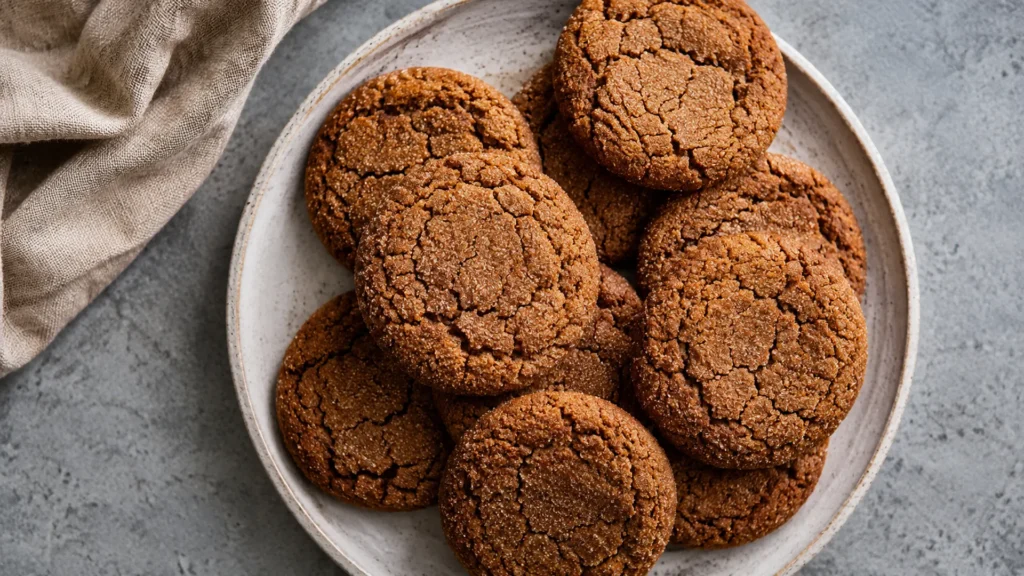
Molasses cookies are soft, chewy spice cookies built around dark molasses, rolled in sugar, and baked until the tops crackle. The good ones stay tender for days, carry a warm hit of ginger and cinnamon, and have that signature crinkled, sugar-frosted surface. The disappointing ones come out dry, bitter, or flat with no crackle at all. None of that is mysterious. The chewiness comes from molasses doing a specific job, the bitterness comes from using the wrong grade of molasses, and the crackle comes from the sugar roll. This guide explains all three, walks through the method, and gives you a spice blend and troubleshooting table so your cookies land soft, sweet, and spiced every time.
These are a cold-weather classic and a fixture on holiday plates, close cousins to gingersnaps but softer and chewier rather than crisp. They keep well, they ship well, and they smell like the whole season while they bake. If you can stir a dough and roll a ball in sugar, you can make them. The details below are what separate a bakery-quality molasses cookie from a dry, one-note one.
Molasses cookies have deep roots in American home baking. Molasses was the everyday sweetener in many households long before refined white sugar became cheap and common, so molasses-sweetened spice cookies were a pantry staple for generations, especially in colder regions and around the winter holidays. That history is part of why the flavor reads as nostalgic and seasonal: these are the cookies a lot of people associate with a grandparent’s kitchen. The modern recipe is essentially the same idea, just with the spice blend dialed in and the bake controlled for a reliably soft result.
Why molasses makes cookies chewy
The chewiness is not an accident of the recipe; it is molasses doing chemistry. Molasses is hygroscopic, meaning it attracts and holds onto moisture. In a cookie, that means the molasses keeps water in the crumb instead of letting it bake out, so the cookies stay soft and chewy well after they cool, and for days in the container. This is the same reason brown sugar, which contains molasses, makes cookies chewier than white sugar alone.
That moisture-holding property is why molasses cookies have such good shelf life. While many cookies go stale and hard within a day or two, a proper molasses cookie stays tender for the better part of a week because the molasses keeps pulling moisture back into the crumb. If your molasses cookies come out dry, the fix is almost never less baking time alone; it is usually too much flour crowding out the molasses, which the troubleshooting section covers. For a deeper look at how molasses behaves in baking, the writers at The Kitchn have documented its moisture chemistry.
This is also why measuring flour accurately matters more in this recipe than in many others. The molasses can only keep the cookie soft if there is the right amount of flour to hold the moisture, not drink it up. A packed measuring cup can hold a quarter more flour than a properly spooned and leveled one, which is enough to turn a chewy molasses cookie into a dry, cakey one. If you own a kitchen scale, weigh the flour. If you do not, fluff the flour in its container, spoon it lightly into the cup, and level it off with a knife rather than scooping the cup straight through the bag. That single habit prevents the most common molasses cookie failure.
Which molasses to use (this is the big one)
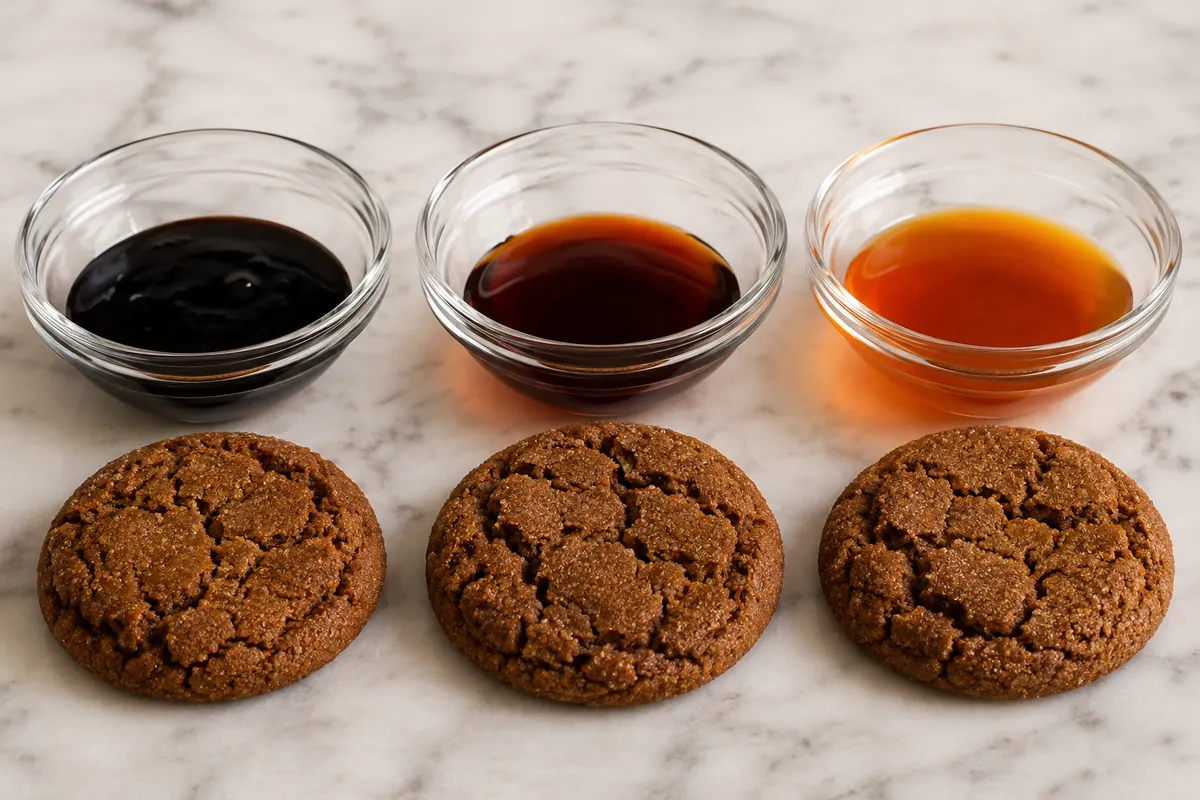
The single most common way to ruin molasses cookies is using the wrong grade of molasses. There are three types on the shelf, and they are not interchangeable.
| Molasses grade | Flavor | Use in cookies? |
|---|---|---|
| Light (mild) molasses | Sweet, mild, from the first boiling | Works, but flavor is faint |
| Dark (full) molasses | Deep, robust, balanced sweet and bitter | Yes, the ideal choice |
| Blackstrap molasses | Very dark, bitter, salty, from the final boiling | No, too bitter for cookies |
Use dark (sometimes labeled full-flavor) unsulphured molasses. It gives the rich, classic flavor without the harsh bitterness. Do not use blackstrap molasses, which comes from the final stage of sugar refining and is bitter and almost salty. Blackstrap has a place in some savory and nutritional uses, but in a cookie it tastes acrid and will make people think they dislike molasses cookies when they really just dislike blackstrap. If your cookies taste bitter, the molasses grade is the first thing to check.
The spice blend
Molasses gives the depth; the spices give the warmth. The classic blend is ginger-forward with cinnamon and a little clove, and you can adjust to taste. Ground ginger is the lead, cinnamon is the supporting body, and cloves add the aromatic edge that makes the cookie smell like the holidays.
| Spice | Amount (1 batch) | Role |
|---|---|---|
| Ground ginger | 1.5 to 2 tsp | The lead warmth and bite |
| Cinnamon | 1 tsp | Rounded, sweet body |
| Ground cloves | 1/4 to 1/2 tsp | Aromatic, holiday edge |
| Nutmeg or allspice (optional) | 1/4 tsp | Extra depth |
A small pinch of black pepper or a little extra ginger pushes the cookie toward a spicier, gingersnap-leaning profile. Keep in mind that molasses cookies and gingersnaps are close relatives: the main difference is texture, with molasses cookies baked soft and chewy and gingersnaps baked crisp and snappy. The spice blend can be nearly identical; the bake and the fat ratio are what set them apart.
Ingredients and what each one does
| Ingredient | Amount | What it does |
|---|---|---|
| Unsalted butter, softened | 3/4 cup | Flavor and tenderness |
| Brown sugar | 1 cup, packed | Moisture and chew; reinforces the molasses |
| Egg | 1 large | Binding and structure |
| Dark molasses | 1/4 cup | The flavor, color, and chew |
| All-purpose flour | 2 1/4 cups | Structure |
| Baking soda | 2 tsp | Lift and the crackle; reacts with the acidic molasses |
| Spice blend | see chart | Warmth |
| Salt | 1/2 tsp | Balances sweetness |
| Granulated sugar (for rolling) | 1/3 cup | The crackled, frosted top |
Note the baking soda, not baking powder. Molasses is acidic, and baking soda reacts with that acid to give both lift and the cracked top. Brown sugar rather than all white sugar in the dough is deliberate too, because its own molasses content reinforces the chew. The test kitchen at America’s Test Kitchen has tested how the soda-and-molasses reaction drives the crackle, and it is the same mechanism here.
Step by step
1. Cream and add molasses
Beat the softened butter and brown sugar until creamy, about two minutes. Beat in the egg and the molasses until smooth. The dough will take on a deep brown color from the molasses.
2. Add the dry ingredients
Whisk the flour, baking soda, spices, and salt in a separate bowl, then stir into the wet mixture until just combined. Do not overmix once the flour is in, or the cookies turn tough. The dough will be soft.
3. Chill briefly
Chill the dough for about 30 minutes to an hour. It is soft and sticky from the molasses, and a short chill makes it possible to roll into balls and reduces spread. You do not need a long overnight chill for these.
4. Roll in sugar and bake
Heat the oven to 350 F (175 C). Roll the chilled dough into balls, then roll each in granulated sugar to coat. Place on a lined sheet a couple of inches apart. Bake 9 to 11 minutes, until the tops have crackled and the edges are set but the centers still look soft. Pull them then; they finish setting on the pan and stay chewy.
Getting the crackled top
The crinkled, sugar-frosted top is the signature look, and it comes from the same forces as other crackle cookies. The sugar coating on the surface stays drier and more rigid than the dough underneath, so as the cookie rises and spreads, the surface splits and the dark dough shows through the white sugar. The baking soda reacting with the acidic molasses provides the rise that drives those cracks.
For the most defined crackle, coat the dough balls generously in granulated sugar and do not flatten them before baking. Let the spread happen in the oven so the cracks form naturally. If your cookies bake up smooth with no cracks, the usual causes are too little baking soda, dough that was too warm and spread before it could rise, or balls that were pressed flat. The same crackle principle drives our Christmas cookie favorites that get rolled in sugar.
Soft and chewy versus crisp
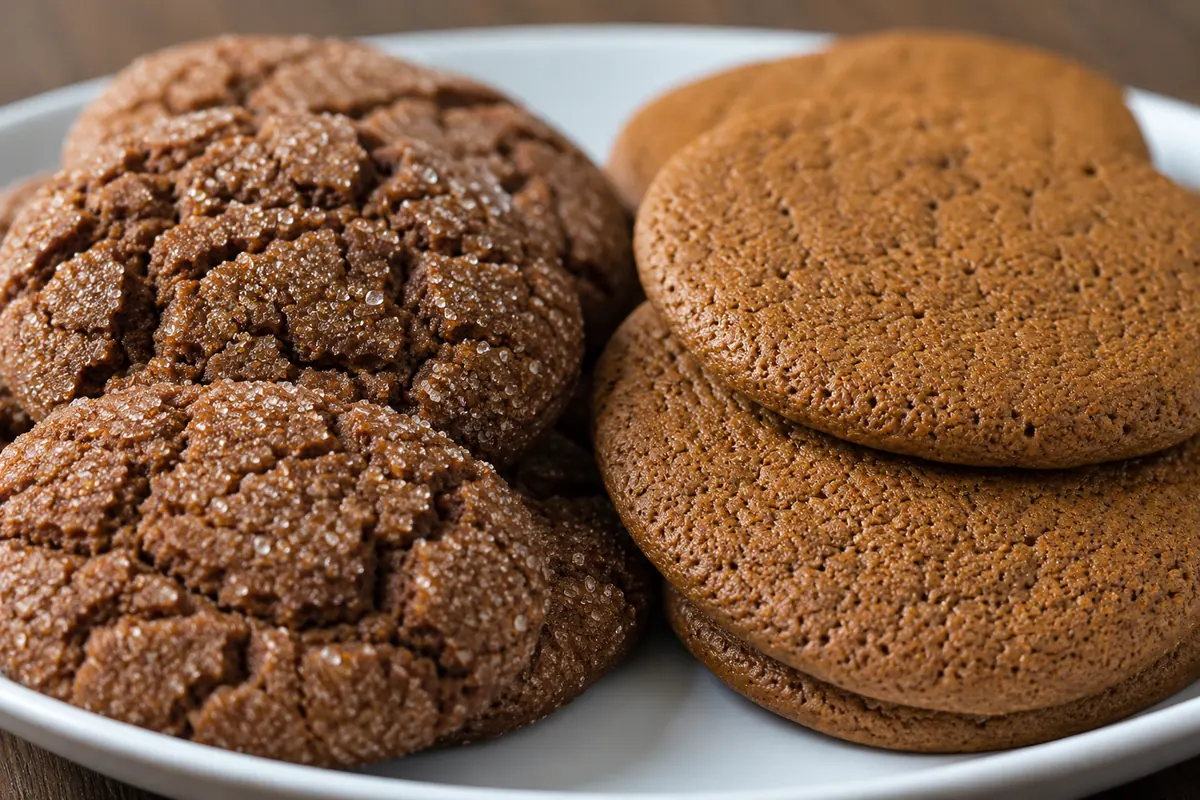
You can steer these toward soft-chewy (the classic) or toward crisp, gingersnap territory with a few changes.
| For soft and chewy | For crisp |
|---|---|
| More brown sugar | More white sugar |
| Pull early, underbaked center | Bake longer until set through |
| Thicker dough balls | Flatten the dough balls |
| Store airtight to keep moisture | Store loosely to let them dry and crisp |
Most people want the soft, chewy version, which is why the recipe leans on brown sugar and an early pull. The early pull is the same instinct that keeps an oatmeal cookie chewy: the centers finish setting on the hot pan after you take them out, so a cookie that looks fully baked in the oven has already gone a step too far toward dry.
Make-ahead, storage, and freezing
Molasses cookies are an excellent make-ahead cookie because the molasses keeps them soft. Baked cookies stay tender in an airtight container for up to a week, longer than most cookies. Tuck a slice of bread into the container to keep them extra soft if you like; the cookies pull moisture from the bread.
The dough freezes well. Roll it into balls, freeze them solid on a tray, then bag them and bake from frozen, adding a minute or two and rolling in sugar just before baking. Baked cookies also freeze for up to three months. For the general rules on what freezes cleanly, see our guide on whether you can freeze cookie dough. Because they hold up so well, these travel and ship better than delicate cookies, which is part of why they are a holiday-gifting staple.
Troubleshooting molasses cookies
| Problem | Likely cause | Fix |
|---|---|---|
| Bitter or harsh flavor | Blackstrap molasses | Switch to dark (full-flavor) unsulphured molasses |
| Dry, hard cookies | Too much flour or overbaked | Weigh flour; pull when centers look soft |
| No crackle on top | Too little soda, warm dough, or flattened balls | Check soda is fresh; chill dough; do not press flat |
| Cookies spread too thin | Dough too warm or too soft | Chill the dough 30 to 60 minutes |
| Faint, weak flavor | Light molasses or too little spice | Use dark molasses; bump the ginger |
| Tough, dense texture | Overmixed after adding flour | Stir only until combined |
Two issues account for most complaints: bitterness, which is almost always blackstrap molasses, and dryness, which is almost always too much flour or an overbake. Fix the molasses grade and measure flour by weight, and the rest of the recipe is forgiving.
Variations
Molasses cookies take well to small twists. Add a tablespoon of finely chopped crystallized ginger for bursts of bright, chewy ginger. Dip half of each cooled cookie in white chocolate for a holiday look, or sandwich two with a thin layer of cream cheese frosting. For a deeper flavor, brown the butter before creaming. You can also lean into the gingersnap side by using more ginger and baking the cookies longer and flatter for a crisp snap. Whatever you change, keep the dark molasses and the baking soda, because those two are what make the cookie taste and look like a molasses cookie rather than a generic spice cookie. A platter of these alongside sugar cookies gives a holiday spread both a sweet and a spiced option.
One variation worth calling out is the orange-molasses cookie. Adding the zest of an orange to the dough brightens the deep, dark molasses with a citrus lift that keeps the cookie from feeling heavy, and it pairs beautifully with the cloves. A teaspoon of zest is enough; you want a hint, not a marmalade flavor. For an adult version, a splash of dark rum or a little espresso powder in the dough deepens the molasses without anyone being able to name exactly what you added. These small additions turn a familiar cookie into something that tastes considered, while keeping the soft, chewy, crackle-topped character intact.
Frequently asked questions
What kind of molasses is best for cookies?
Dark, full-flavor unsulphured molasses. It gives the rich, classic taste without bitterness. Light molasses works but tastes faint, and blackstrap molasses is too bitter and salty for cookies. If your molasses cookies taste harsh, the molasses grade is almost always the cause.
Why are my molasses cookies dry?
Usually too much flour or overbaking. Molasses is hygroscopic and keeps cookies moist, but too much flour crowds it out, and an overbake drives off the moisture. Weigh your flour and pull the cookies while the centers still look soft, since they finish setting on the pan.
Why did my molasses cookies not crackle?
The crackle needs the cookie to rise and split its sugar coating. Too little baking soda, dough that was too warm and spread before it could rise, or dough balls pressed flat all prevent it. Use fresh baking soda, chill the dough, roll the balls generously in sugar, and do not flatten them.
What is the difference between molasses cookies and gingersnaps?
Mainly texture. Molasses cookies are baked soft and chewy; gingersnaps are baked crisp and snappy. The spice blend can be nearly identical. You get a gingersnap by using more white sugar, flattening the dough, and baking longer until the cookie sets crisp all the way through.
Do I have to chill the dough?
A short chill helps. Molasses dough is soft and sticky, so 30 minutes to an hour in the refrigerator makes it possible to roll into balls and reduces spread. You do not need a long overnight chill for these the way you do for some other cookies.
How long do molasses cookies stay fresh?
Up to a week in an airtight container, longer than most cookies, because the molasses keeps pulling moisture into the crumb. A slice of bread in the container helps them stay extra soft. They also freeze well for up to three months, baked or as dough balls.
Bottom line
A great molasses cookie comes down to three decisions. Use dark, full-flavor molasses, never blackstrap, so the cookie tastes rich instead of bitter. Lean on brown sugar and pull the cookies while the centers still look soft so the molasses can keep them chewy for days. And roll the dough balls generously in sugar without flattening them so the tops crackle the way they should. Add a ginger-forward spice blend, chill the soft dough briefly, and you get a tender, warmly spiced cookie that keeps for a week and smells like the whole season. Get the molasses grade right, weigh your flour, and the rest is easy and forgiving.