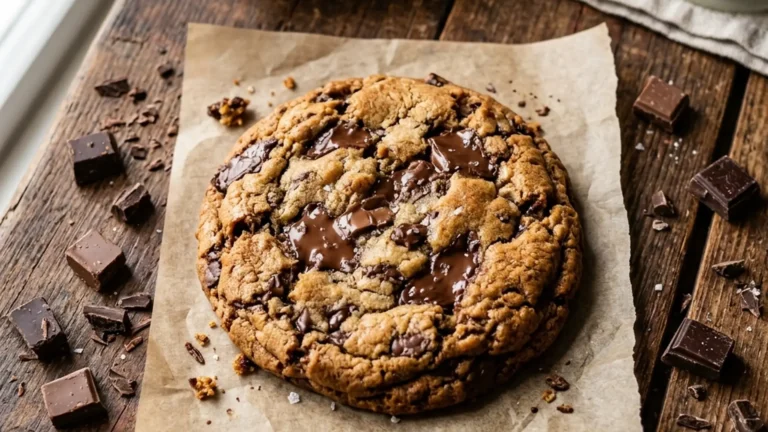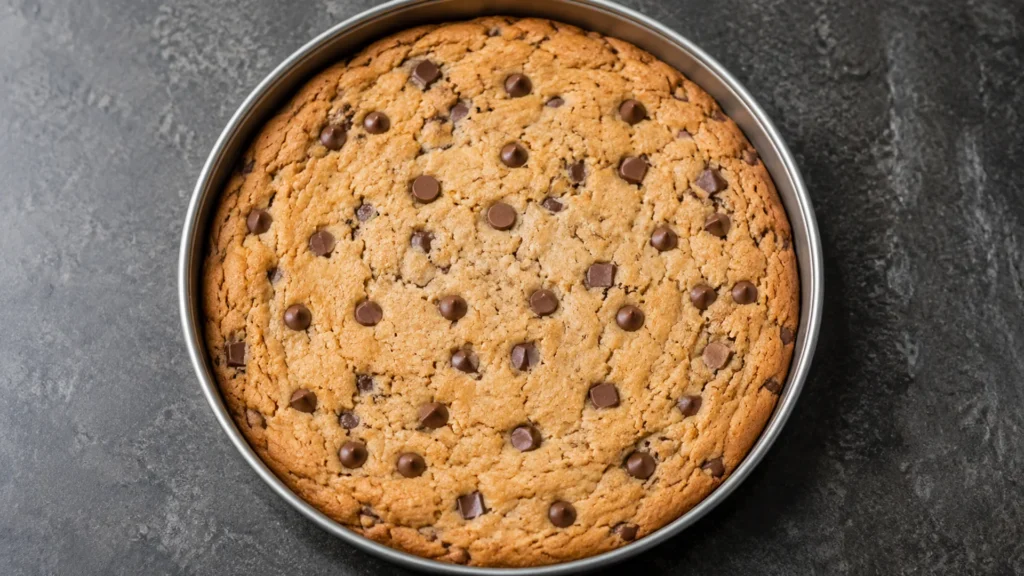
A cookie cake is a single oversized chocolate chip cookie baked in a round pan, cut into wedges like a cake, and usually finished with a piped frosting border. Done right, it is chewy in the middle, crisp at the rim, and miles better than the mall-counter version. Done wrong, it bakes up dry and cakey, or it stays raw in the center while the edges turn to concrete. The difference comes down to three things you control: how you cream the butter, how thick you press the dough, and how you read the bake. This guide walks through all three, gives you a pan-size chart so you are not guessing, and covers frosting, make-ahead, transport, and the fixes for every common failure.
I bake these for birthdays more than any other dessert, because one pan feeds a crowd, there is no layering or crumb coat, and a seven-year-old can help press the dough. If you can make drop cookies, you can make this. The recipe below scales cleanly, and the science notes tell you why each step matters so you can adjust with confidence instead of hoping.
What a cookie cake actually is
At its core a cookie cake is chocolate chip cookie dough, the same kind you would scoop into individual cookies, pressed into a cake pan and baked as one piece. It is not a true cake. There is no leavening-heavy crumb, no creaming-for-volume step, and no cake flour. The texture you are after is the chewy, slightly underbaked center of a great bakery cookie, scaled up to ten or twelve inches across.
Because it bakes as a single thick disc, a cookie cake behaves differently from individual cookies. The center is insulated by the surrounding dough, so it takes longer to set and is easy to underbake. The edges, sitting against a hot metal rim, firm up fast. Your job is to get the middle cooked through to a soft set while the edges stay short of hard. Thickness and oven temperature are the two levers that make that possible.
It helps to know where the cookie cake came from, because the format explains the texture. The dessert was popularized in the United States by mall bakery chains in the 1980s, sold by the slice from a glass case and decorated to order. Those counter versions were built to hold up under a heat lamp for hours, which is why they often skewed dry and overly sweet. The home version has no such constraint, so you can bake it softer, pull it earlier, and frost it lightly. That freedom is the whole reason a homemade cookie cake beats the one you remember from the food court, and it is why the doneness cue matters more than any clock.
The one rule that keeps it chewy, not cakey
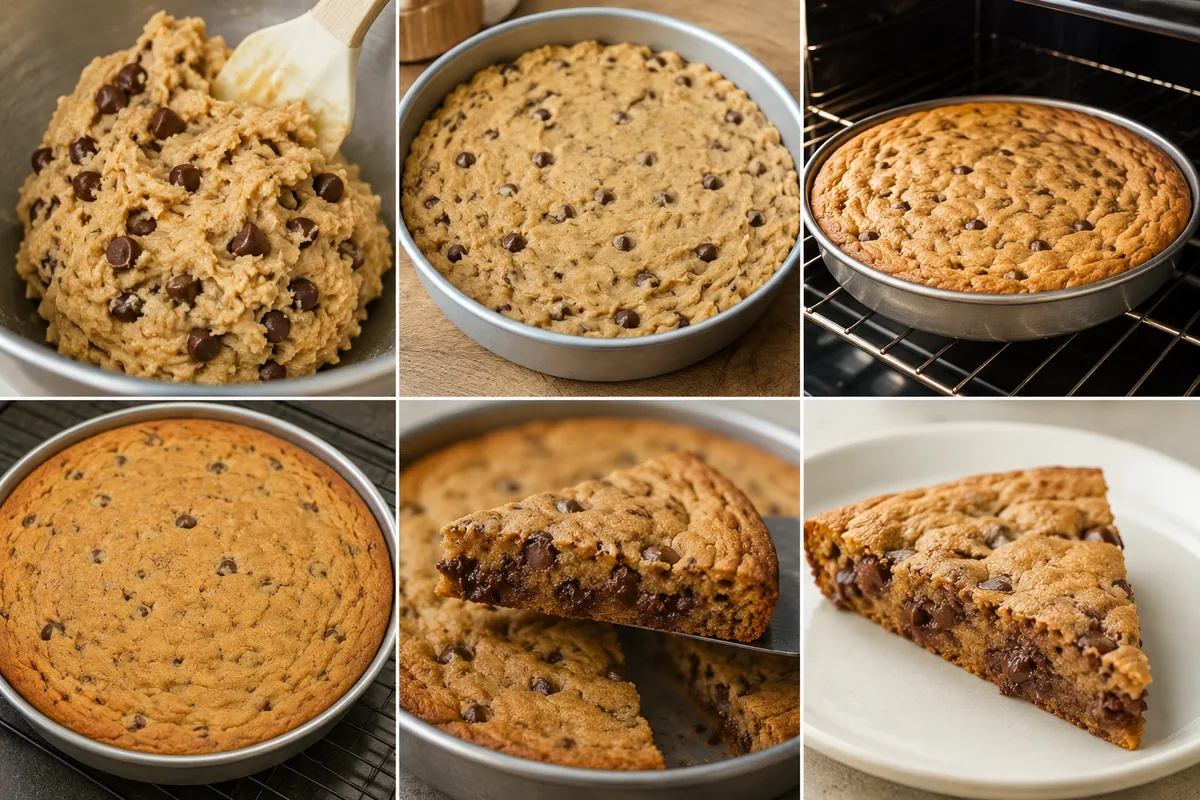
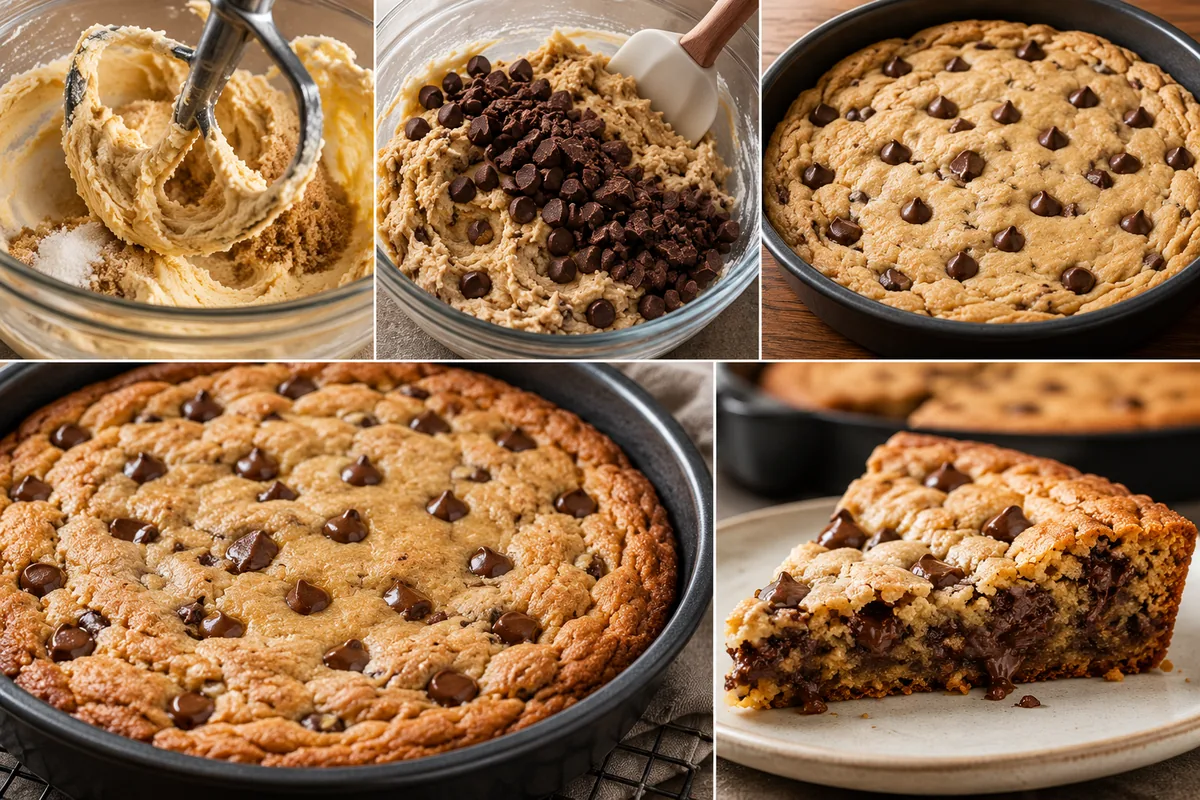
The single most common mistake is treating the dough like cake batter. For a layer cake you beat butter and sugar until pale and fluffy, on purpose, to whip air into the fat so the cake rises light. For a cookie cake you want the opposite. Cream the softened butter and sugars only until they are combined and smooth, roughly one to two minutes, and stop. Less air in the dough means less puff and rise, which gives you a dense, chewy slab instead of a tall, crumbly one.
The second half of the chewy rule is thickness. Press the dough to a roughly half-inch even layer. Thicker than that and the center struggles to cook before the edges overbake. Much thinner and the whole thing crisps into a giant wafer with no chew. Half an inch is the sweet spot for a soft middle and a defined edge.
A small amount of cornstarch (about two teaspoons in a standard batch) helps too. It softens the structure and keeps the crumb tender, the same trick that makes many bakery-style drop cookies chewy. If you want to understand why cornstarch and an extra egg yolk push texture toward chewy, the recipe science writers at America’s Test Kitchen have tested the mechanism in depth, and it applies directly here.
Ingredients and what each one does
You do not need anything exotic. The interest is in the ratios, not the shopping list. Here is what goes in a standard nine-inch cookie cake and the job each ingredient is doing.
| Ingredient | Amount (9-inch) | What it does |
|---|---|---|
| Unsalted butter, softened | 1/2 cup (1 stick) | Flavor and tenderness; softened, not melted, for controlled spread |
| Brown sugar | 1/2 cup, packed | Moisture and chew; its molasses keeps the center soft |
| Granulated sugar | 1/4 cup | Crisp edges and structure |
| Egg plus 1 yolk | 1 large + 1 yolk | Binding and richness; the extra yolk adds chew |
| Vanilla extract | 1.5 tsp | Flavor depth |
| All-purpose flour | 1 1/3 cups | Structure; measure by weight if you can |
| Cornstarch | 2 tsp | Softer, more tender crumb |
| Baking soda | 1/2 tsp | Light lift and browning |
| Salt | 1/2 tsp | Balances sweetness, sharpens flavor |
| Chocolate chips | 3/4 to 1 cup | The point of the whole thing |
Two ingredient notes save most failures. Use softened butter, not melted: melted butter makes the dough greasy and the cake spreads and turns crisp instead of chewy. And measure flour by weight if you own a scale (about 165 grams for the amount above). Too much flour is the number one cause of a dry, crumbly cookie cake, because a packed measuring cup can hold far more than a spooned and leveled one.
Step by step: baking the cookie cake
The method is short. Read it once, then work in order.
1. Prep the pan and oven
Heat the oven to 350 F (175 C). Line the bottom of a round cake pan or springform with parchment and lightly grease the sides. A springform makes release effortless, but a standard cake pan works if you parchment the base. Do not use a deep cake pan you cannot easily reach into to lift the cake out.
2. Make the dough
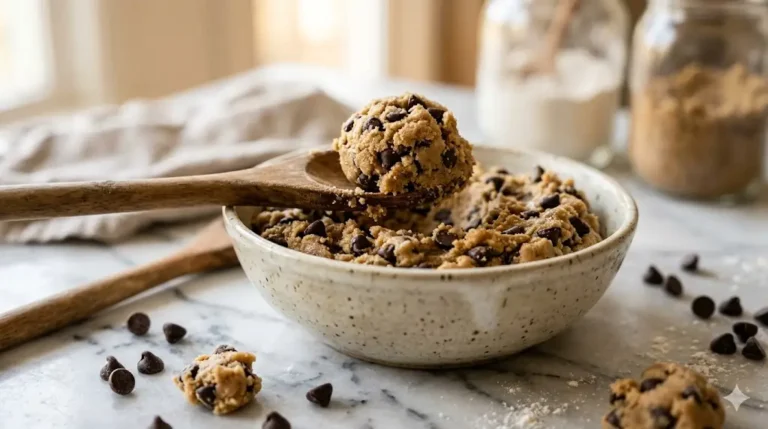
Cream the softened butter with both sugars just until smooth and combined, one to two minutes, no longer. Beat in the egg, the extra yolk, and the vanilla until creamy. In a separate bowl whisk the flour, cornstarch, baking soda, and salt, then add to the wet mix and stir only until no dry streaks remain. Fold in the chocolate chips. The dough should be soft but scoopable, not runny.
3. Press and bake
Scrape the dough into the pan and press it into an even half-inch layer with your fingers or the back of a greased measuring cup. Leave a small gap at the very edge if you want a clean rim. Bake 18 to 22 minutes for a nine-inch pan, until the edges are golden and set and the center looks puffed but slightly underdone. Pull it before the middle looks fully baked. It will finish setting as it cools.
4. Cool completely before frosting
Let the cake cool in the pan on a rack for at least 30 to 40 minutes before you try to move or frost it. Warm cookie cake is fragile and will crack or tear. Cooling also lets the chewy center finish setting, which is the texture you came for. If you slice it warm you trade chew for a gooey, falling-apart wedge.
Pan size, bake time, and dough chart
The recipe above is sized for a nine-inch round. Scaling up or down changes the dough quantity and the bake time. Use this chart to hit the right thickness in any common pan. Times are a starting range; always judge by the visual cue (set edges, slightly underdone center).
| Pan size | Dough (approx.) | Bake time at 350 F | Serves |
|---|---|---|---|
| 8-inch round | 1x batch | 16 to 20 min | 8 |
| 9-inch round | 1x batch | 18 to 22 min | 10 |
| 10-inch round | 1.5x batch | 20 to 25 min | 12 |
| 12-inch round / pizza pan | 2x batch | 22 to 28 min | 16 |
| Quarter sheet pan | 2x batch | 20 to 26 min | 16 to 20 |
The thickness target stays the same across every size: roughly half an inch of dough. If you double the batch for a 12-inch pan but press it thicker than half an inch, you are back to a raw center. Match dough to pan so the depth lands where it should.
Frosting your cookie cake
The classic finish is a piped border of frosting around the rim with a message written in the center, leaving most of the cookie surface bare so it still reads as a cookie. You only need enough frosting for that border, which is why a cookie cake is far less work than a layer cake. Three frostings cover almost every preference.
| Frosting | Flavor and texture | Best for |
|---|---|---|
| American buttercream | Sweet, smooth, pipes crisp borders and holds color | Birthday messages, colored borders |
| Chocolate fudge frosting | Rich, deep, glossy, soft set | Chocolate lovers, a fudgier finish |
| Cream cheese frosting | Tangy, less sweet, softer pipe | Cutting sweetness, fall and holiday cakes |
For a clean border, fit a piping bag with a star tip and pipe rosettes or a shell pattern around the edge. Chill the frosted cake for 15 minutes before slicing so the border holds its shape. If you are writing a name, use a contrasting color in a small round tip and pipe slowly. For frosting technique and ratios that pipe well, the baking guides at King Arthur Baking are a reliable reference.
Make-ahead, storage, and transport
A cookie cake is a great make-ahead dessert, which is part of why it beats a layer cake for a party. The baked, unfrosted cookie keeps at room temperature, well wrapped, for three to four days and still tastes fresh. Frost it the day of the event for the cleanest look.
To freeze, wrap the cooled, unfrosted cake tightly in plastic and then foil, and freeze for up to three months. Thaw at room temperature for a couple of hours before frosting. You can also freeze the raw dough pressed into a parchment-lined pan, then bake from frozen, adding a few minutes to the time. For the rules on what does and does not freeze well in cookie dough, see our guide on whether you can freeze cookie dough.
For transport, leave the cake on a flat cardboard round or in the springform base, and carry it level. Frosting borders smear if the cake tilts. If you are driving far, chill the frosted cake first so the border is firm, and keep it flat in the trunk rather than on a seat.
Troubleshooting a cookie cake
Almost every problem traces back to one of three causes: dough thickness, oven behavior, or too much flour. This table maps the symptom to the fix.
| Problem | Likely cause | Fix |
|---|---|---|
| Raw, gooey center | Dough too thick or pulled too early at the rim | Press thinner; lower temp 25 F and bake longer; tent edges with foil |
| Dry, cakey crumb | Too much flour or overcreamed butter | Weigh flour; cream only until combined, not fluffy |
| Hard, crunchy edges | Overbaked or melted butter used | Pull when center still looks underdone; use softened butter |
| Spread thin and greasy | Melted butter or warm dough | Use softened butter; chill dough 20 min before baking |
| Sunken middle | Underbaked center collapsed | Bake a few minutes longer; check center is puffed and set |
| Stuck in the pan | No parchment on the base | Always parchment the bottom; cool before releasing |
If your cake spreads too thin and crisp every time, the cause is usually butter temperature, the same issue behind flat drop cookies. Our breakdown of why cookies turn out flat covers the butter and chilling fixes that apply directly to a cookie cake.
Variations worth trying
The base dough is a launchpad. Swap the chocolate chips for a mix of milk and dark, add chopped toasted pecans for crunch, or stir in a handful of M and M candies for color a kid will love. For a deeper, butterscotch-leaning flavor, brown the butter first, then let it cool and resolidify slightly before creaming, the technique behind our brown butter chocolate chip cookies.
You can also lean into other classic cookie doughs. A chocolate chip cookie base is the standard, but a sugar cookie or peanut butter dough works in the same pan with the same thickness rule. Just keep the half-inch depth and the bake-by-look approach, and any dough that makes a good drop cookie will make a good cookie cake.
Frequently asked questions
What is the difference between a cookie cake and a regular cake?
A cookie cake is one giant cookie baked in a cake pan, with a dense, chewy texture and no real crumb. A regular cake uses a batter built to rise light and airy. A cookie cake skips the creaming-for-volume step and the leavening-heavy structure, so it eats like a thick cookie, not a slice of sponge.
Why is my cookie cake raw in the middle?
Either the dough was pressed too thick or you judged doneness by the edges. The center is insulated and cooks slowest. Press the dough to about half an inch, and if the edges set before the middle does, drop the oven to 325 F, tent the rim with foil, and give the center a few more minutes.
Can I make a cookie cake without a springform pan?
Yes. Any round cake pan works as long as you line the bottom with parchment and grease the sides. A springform just makes release easier. You can also use a pizza pan or a quarter sheet pan; adjust the dough quantity to keep the half-inch thickness.
How far in advance can I make a cookie cake?
Bake it up to three or four days ahead and store it wrapped at room temperature, or freeze the unfrosted cake for up to three months. Frost it the day you serve it for the cleanest border and freshest look.
Do I need to chill the dough?
Not always, but a 20-minute chill helps if your kitchen is warm or your butter softened too much. Chilled dough spreads less and bakes thicker, which protects the chewy center. If the dough is already firm and cool, you can press and bake right away.
How do I keep the frosting border from smearing?
Cool the cake completely, frost it, then chill it for about 15 minutes so the border firms up before slicing or transporting. Carry the cake flat and level. A warm cake or a tilted box is what smears the piping.
Bottom line
A great cookie cake is not a baking-skill flex, it is three habits: cream the butter only until smooth so it stays chewy, press the dough to a half-inch so the center cooks through, and pull it from the oven while the middle still looks slightly underdone. Match your dough to your pan with the chart, cool it fully before frosting, and finish with a simple piped border. Do that and you get a chewy, crowd-feeding dessert that costs a few dollars, takes one bowl, and beats anything from a mall counter. Keep the half-inch rule in your head and the rest is just decoration.