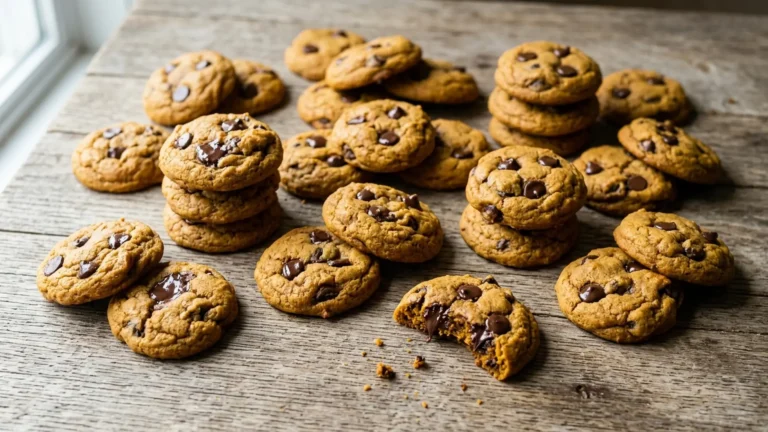
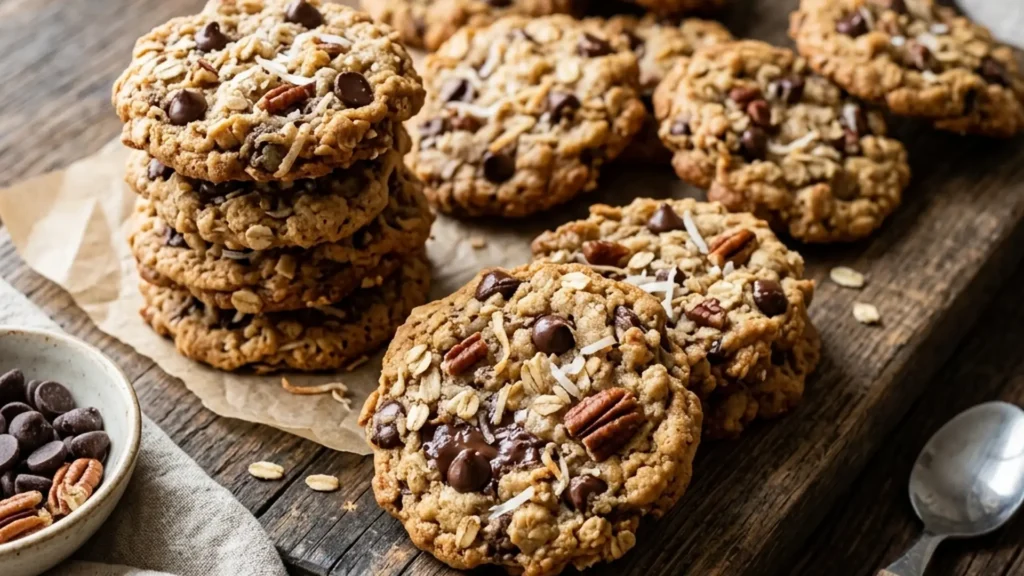
Cowboy cookies are oatmeal cookies that grew up rough and rugged, loaded with chocolate chips, coconut, pecans, and enough oats to call them a meal. What separates a real cowboy cookie from a sad oatmeal cookie with stuff thrown in is balance: the right ratio of mix-ins to dough, brown butter for depth, and a structure sturdy enough that the cookie supposedly traveled in a saddlebag without crumbling. Get those three right and you have a thick, chewy, crisp-edged cookie that stays good for most of a week.
Here is the quick version. Cowboy cookies are loaded oatmeal cookies built on a brown-sugar-heavy dough with old-fashioned oats, shredded coconut, chopped pecans, and chocolate chips. Brown the butter, keep the total mix-ins to about 4 cups, scoop them big, and bake at 350F for 11 to 13 minutes until the edges set but the centers stay soft. The oats and coconut are not just flavor; they soak up moisture and hold the cookie together.
What Makes a Cowboy Cookie a Cowboy Cookie
The short definition is an oatmeal chocolate chip cookie with two extras baked into its identity: coconut and pecans. Take those away and you just have oatmeal chocolate chip. Cinnamon shows up in most versions and is worth keeping; it ties the brown butter and the coconut together. The legend says cowboys carried these on the trail because they were filling and did not fall apart, which is partly marketing and partly true. The oats and coconut really do make a denser, more durable cookie than a plain butter-and-flour dough.
The recipe got a real boost in popularity in 2000, when Laura Bush’s loaded, Texas-sized cowboy cookie won the Family Circle presidential bake-off. That version leaned into the cinnamon and doubled the mix-ins, and it set the template most home bakers follow today. You do not need a famous recipe to make these well, though. You need the ratio right.
The name is more folklore than documented history. There is no single ranch or trail cook who can take credit, and the cookie as we know it really took shape in mid-twentieth-century American home baking, when oats and chocolate chips were pantry staples. What stuck is the spirit of it: a big, hearty, no-fuss cookie packed with whatever good stuff was on hand. That flexibility is exactly why the recipe has lasted, and why treating it as a ratio rather than a rigid ingredient list serves you better than copying any one version.
The Mix-In Ratio That Keeps the Dough Together
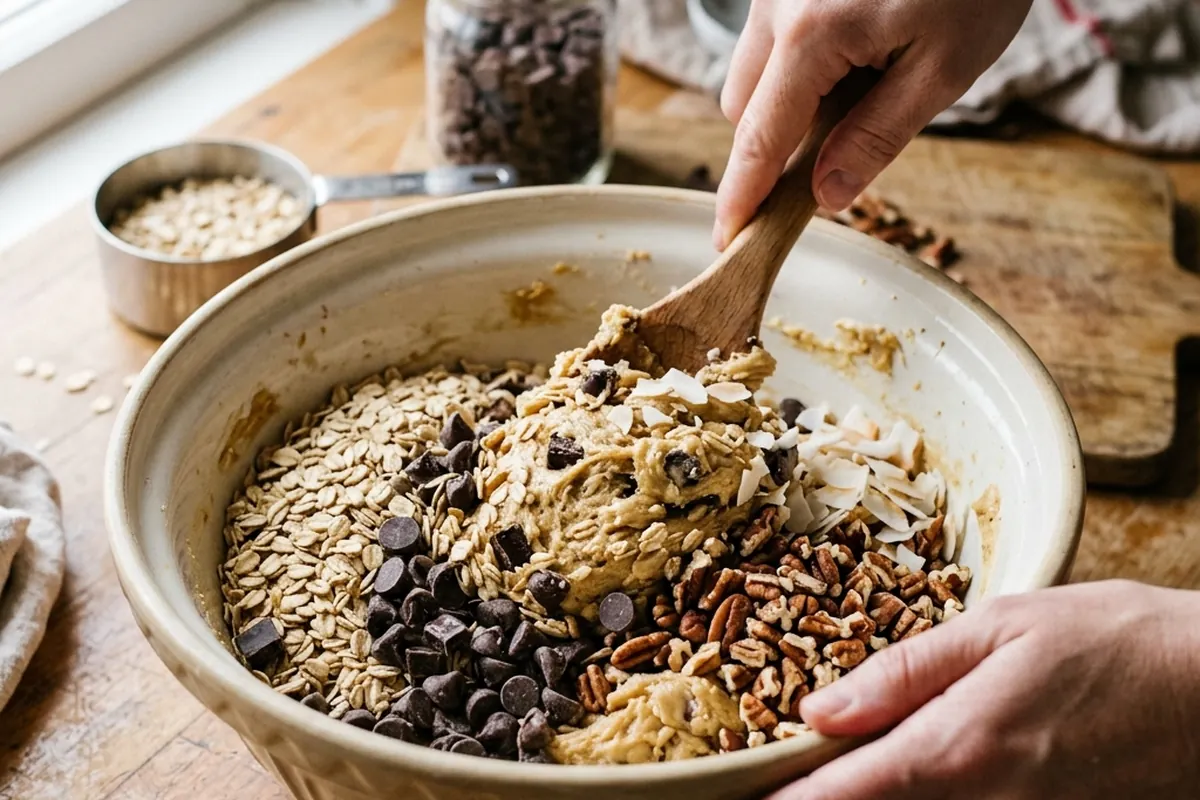
This is the thing the popular recipes never spell out, and it is the single most useful idea in this whole article. A standard cowboy cookie dough built on 2 cups of flour can carry about 4 cups of total mix-ins before it stops being a cookie and starts being a pile of debris held together by hope. Stay near that number and you can swap freely.
| Component | Amount | You can swap for |
|---|---|---|
| Old-fashioned oats | 2 cups | keep as is (the backbone) |
| Chocolate chips | 1.25 cups | dark chunks, butterscotch, M and M’s |
| Chopped pecans | 0.75 cup | walnuts, almonds, toasted (omit for nut-free) |
| Shredded coconut | 0.75 cup | raisins, dried cranberries, chopped dates |
That totals about 4.75 cups, which is the upper end and still works because oats and coconut absorb moisture and act like sponges that bind the dough. If you go heavier on chocolate and lighter on oats, the cookies spread more and crumble. Keep oats at 2 cups and you have a stable base no matter what else you add. You can drop the coconut a touch and bump the chocolate to taste, but leave the oats alone.
Why the Cookie Holds Together
Three things give cowboy cookies their famous durability. Old-fashioned oats absorb water and starch, knitting the crumb. Brown sugar is hygroscopic, so it holds onto moisture and keeps the inside chewy rather than dry and shattery. And an extra egg yolk adds fat and emulsifiers that make the structure flexible instead of brittle. Together they build a cookie that bends a little before it breaks, which is exactly what you want in something meant to survive a lunchbox or a long drive.
Why You Should Brown the Butter
Plain melted butter makes a fine cowboy cookie. Browned butter makes a great one. When you cook butter past melting, the milk solids toast and turn nutty and caramel-scented, and that flavor runs right into the dough. For a batch this loaded with sweet mix-ins, that deeper, slightly savory note keeps the whole thing from tasting one-dimensional. America’s Test Kitchen has done extensive work on brown butter in cookies and found it measurably deepens flavor without changing the structure much, as long as you account for the small amount of water that boils off (see their cookie testing at America’s Test Kitchen).
To brown butter, melt 1 cup in a light-colored pan over medium heat, swirling, until it foams, then smells nutty and the milk solids at the bottom turn golden brown, about 5 to 7 minutes. Pour it out immediately, solids and all, or it will scorch. Let it cool until it is no longer hot, then chill it back to a soft, scoopable state before creaming. Browning drives off some water, so add 1 tablespoon of milk to the dough to compensate.
Step by Step Cowboy Cookies
Cream the cooled browned butter with 1.5 cups packed brown sugar and 0.5 cup granulated sugar until smooth, about 2 minutes. Beat in 2 large eggs plus 1 yolk, 2 teaspoons vanilla, and 1 tablespoon milk. In another bowl whisk 2.25 cups all-purpose flour, 1 teaspoon baking soda, 1 teaspoon cinnamon, and 0.5 teaspoon fine salt. Fold the dry into the wet until almost combined, then fold in the oats, coconut, pecans, and chocolate. The dough will be thick.
Chill the dough at least 30 minutes; this firms the browned butter back up and stops the cookies from spreading thin. Scoop large 2.5-tablespoon mounds, space them 2 inches apart, and bake at 350F for 11 to 13 minutes until the edges are set and golden but the centers still look soft. Let them rest on the hot sheet 5 minutes. Press a few extra chips into the warm tops if you want them to look bakery-pretty.
Troubleshooting Cowboy Cookies
If your cookies spread into flat lace, your butter was too warm or you skipped the chill. Cold dough and a cool baking sheet fix it. If they came out dry and crumbly, you either used quick or instant oats instead of old-fashioned, used unsweetened coconut, or packed in too much flour by scooping. Old-fashioned oats and the spoon-and-level method solve most dryness. If the centers are raw while the edges burn, your dough balls are too big for the temperature; flatten them slightly or drop the oven to 340F and bake a touch longer.
One more: if the cookies taste flat despite all those mix-ins, add salt. A loaded sweet cookie needs 0.5 teaspoon in the dough plus a little flaky salt on top to keep every bite from blurring into sugar. Salt is what makes the chocolate read as chocolate and the brown butter read as nutty.
Dairy-Free and High-Altitude Versions
For a dairy-free cowboy cookie, use a plant butter with at least 79 percent fat and brown it the same way, though it browns faster and can taste slightly different, so watch it closely. Use dairy-free chocolate chips and check that your coconut is unsweetened-free of milk derivatives. The dough behaves nearly the same, but plant butter holds less water, so add an extra tablespoon of milk substitute.
Above about 3,000 feet, lower the baking soda by a quarter, add 2 tablespoons of flour to firm the structure, and raise the oven to 360 to 365F so the cookies set before they over-spread in the thinner air. Bon Appetit has a clear explainer on how altitude changes baking that is worth a read if you bake in the mountains often (Bon Appetit).
The Texture You Want: Thick and Chewy vs Thin and Crisp
Cowboy cookies are traditionally thick, but you have control. For the classic tall, chewy, soft-centered cookie, chill the dough hard, scoop big mounds without flattening, and pull them while the centers still look underdone. The dough barely spreads and the inside stays moist. For a thinner, crispier cowboy cookie with more caramelized edges, skip the chill, use a little more granulated sugar in place of brown, and flatten each ball slightly before baking. The extra spread thins the cookie and crisps the edges.
The recipe is built to land on thick and chewy. The whole point of a cowboy cookie is heft, that satisfying weight in your hand, and a thin one loses the contrast between crisp edge and soft middle that makes the cookie fun to eat. If you are baking for a cookie tin that needs to travel and stay crunchy, the crisp version holds its texture longer. Pick based on where the cookies are going, not on habit.
Scaling Up for a Crowd
Cowboy cookies are a natural for big batches because the dough is forgiving and the cookies keep well. To double the recipe, double everything except the salt and baking soda, which you should increase by about 1.75 times rather than a full 2, since leavening and seasoning scale a little non-linearly in large doughs. A stand mixer handles a double batch; for a triple, mix in two bowls so your mixer does not strain and the mix-ins distribute evenly.
When you scale up, the biggest mistake is uneven mix-in distribution. Fold the oats and add-ins in by hand with a sturdy spatula rather than letting the mixer do it, because the mixer tends to break the chocolate and crush the pecans into dust. Bake in batches and rotate the trays halfway so the cookies brown evenly; a crowded oven steams the cookies and they come out pale and soft instead of golden. For a bake sale or a holiday spread, scoop and freeze the dough balls ahead, then bake fresh on the day so they taste like you just made them.
Storage, Freezing, and Make-Ahead
Cowboy cookies are built to last. Stored airtight at room temperature they stay good 5 to 7 days, longer than most cookies thanks to the brown sugar and oats holding moisture. Toss a slice of bread in the container to keep them soft. They freeze beautifully baked for up to 3 months in a freezer bag with the air pressed out.
My preferred move is to freeze raw scooped dough balls on a tray until solid, then bag them. Bake from frozen at 350F and add about 2 minutes. Fresh cowboy cookies whenever you want them, no full batch required. If your brown sugar has gone rock hard before you start, the quick fixes in the guide on how to soften brown sugar will save you, since brown sugar is doing real work in this recipe.
Toasting the Mix-Ins Is the Free Upgrade
Here is a step almost no recipe bothers with, and it costs ten minutes. Toast the pecans and the coconut before they go into the dough. Raw pecans taste muted and slightly tannic; toasted, they turn deep and buttery and their aroma fills the whole cookie. Spread them on a dry sheet and toast at 350F for 6 to 8 minutes until fragrant, watching closely because nuts go from golden to burnt fast. Do the coconut separately for 3 to 4 minutes, since it browns quicker than the nuts.
Toasting does two things. It deepens flavor, obviously, but it also drives off a little moisture, which keeps the mix-ins from making the dough soggy and helps the cookies hold their shape. Once you taste a cowboy cookie made with toasted pecans against one made with raw, you will not go back. It is the cheapest flavor upgrade in baking, and it works in nearly any loaded cookie. Let the toasted mix-ins cool completely before folding them in, or their residual heat will start melting the butter in your dough.
Variations Worth Making
Cowboy cookies are a canvas. Swap the pecans for toasted walnuts and the coconut for dried cranberries for a more autumn-leaning cookie, similar in spirit to these pumpkin snickerdoodles if you also add a pinch of nutmeg. For a peanut-forward version, replace half the chocolate chips with peanut butter chips and a handful of chopped peanuts, which pairs with the same flavor logic behind these peanut butter chocolate bars. Just remember the 4-cup mix-in ceiling so the dough still holds together.
Frequently Asked Questions
What is the difference between cowboy cookies and oatmeal cookies?
Cowboy cookies start from an oatmeal cookie base but always add coconut, pecans, and chocolate chips, usually with cinnamon. Plain oatmeal cookies stop at oats and maybe raisins. The coconut and nuts are what make a cowboy cookie.
Can I use quick oats instead of old-fashioned?
You can, but the texture suffers. Quick oats are cut finer and turn the cookie pastier and drier. Old-fashioned rolled oats give the signature chewy, hearty bite and bind the dough better. Avoid instant oats entirely.
Why are my cowboy cookies falling apart?
Usually too many mix-ins for the dough, or not enough binding. Keep total add-ins near 4 cups, keep the oats at 2 cups, and include the extra egg yolk. If the dough still won’t hold, chill it longer so the fat firms up.
Do I have to brown the butter?
No, melted or softened butter works. But browning adds a nutty depth that balances all the sweet mix-ins, and for a cookie this loaded it makes a real difference. If you do brown it, add 1 tablespoon of milk to replace lost moisture.
How long do cowboy cookies stay fresh?
5 to 7 days in an airtight container at room temperature, which is longer than most cookies because the oats and brown sugar hold moisture. A slice of bread in the container keeps them soft, and they freeze for up to 3 months.
Can I make cowboy cookies without nuts?
Yes. Leave out the pecans and either add more oats or more dried fruit to keep the mix-in volume up so the dough stays balanced. The cookies will be a little softer without the crunch but still hold together fine.
Should I chill cowboy cookie dough?
For the thick, chewy version, yes, at least 30 minutes, especially if you browned the butter. Chilling firms the fat back up so the cookies stay tall instead of spreading thin. If you want a thinner, crisper cookie, you can skip the chill and let them spread on purpose.
Why do cowboy cookies have coconut?
Coconut adds chew, a faint sweetness, and texture, but it also pulls double duty as a binder. Like the oats, shredded coconut absorbs moisture and helps the loaded dough hold together. Use sweetened shredded coconut for the classic result; unsweetened reads drier and slightly bland here.
Bottom Line
Cowboy cookies reward you for treating them as a system rather than a list. Hold the oats steady, cap the mix-ins around 4 cups, brown the butter for depth, and chill the dough so it bakes thick. Do that and you get a sturdy, loaded, genuinely satisfying cookie that keeps for days and bends to whatever chips and nuts you have on hand. Make one base batch your way, then never look at another recipe again.